Ulster Strong expands campaign for jobs, investment and smart development
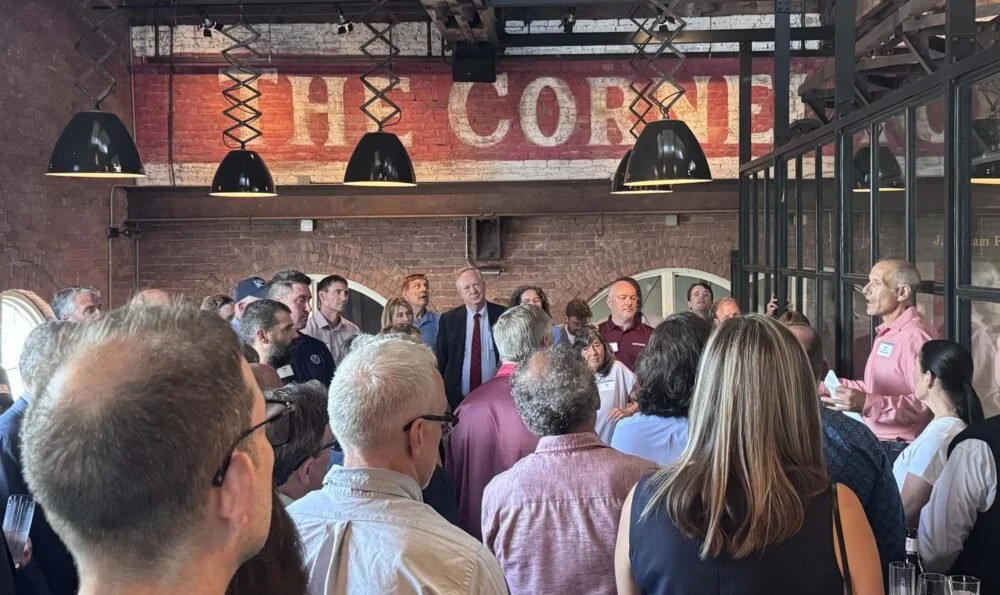
Ulster Strong 2026 Summer Mixer at the Cornell Bar and Restaurant
Originally Published in Hudson Valley One
August 6, 2026
Local business leaders, entrepreneurs and elected officials gathered in the Rondout district to outline a new chapter for regional economic growth as Ulster Strong officially launched its “Ulster Strong 2.0” initiative. The business advocacy coalition used the event to address pressing economic headwinds facing Ulster County, showcase new county-level funding streams for small businesses and urge the local business community to take an active, visible seat at the public planning table. Among those in attendance were Ulster County executive Jen Metzger, Kingston mayor Steve Noble, deputy county executive James Amenta, interim director of the Department of Economic Development Leslie Wellington and county legislator Lindsey Grossman and Amy Dooley.
Ulster Strong chair Don Tallerman introduced Metzger, who announced a significant new economic tool aimed at empowering small enterprises across the county. “Tomorrow, we are opening revitalized standard revolving funds for small businesses at the county level,” Metzger told the crowd. She explained that after extensive discussions with local business owners, the county structured three distinct loan products ranging from $7,500 to $150,000. These financial tools include micro-equipment loans featuring fixed-term, low-interest funding for minor capital purchases that fall below commercial bank thresholds. The county is also offering gap financing that covers up to 25% of a project’s cost alongside commercial bank lending to lower overall capital costs. Additionally, bridge loans are now accessible to both small businesses and nonprofit organizations that are waiting on approved state or federal grant disbursements.
Following Metzger’s remarks, Tallerman addressed the broader economic landscape facing Ulster County, framing the region’s quality of life as its greatest asset while remaining candid about structural challenges. While noting the scenic beauty and cultural appeal of the area, joking that even the South of France does not have anything on Ulster County, Tallerman said, “… the region has experienced net job losses and stagnant population vitality … while the area continues to attract new talent, it is losing key residents to other parts of the country.” Tallerman urged county stakeholders to work collaboratively to create more sustainable local jobs, address rising housing expenses and narrow the widening income disparity within the community.
Clarifying the coalition’s growth philosophy, Tallerman emphasized that Ulster Strong does not advocate for unchecked commercial expansion or rubber-stamp approvals. Citing past opposition to a proposed asphalt plant near the Bluestone Wild Forest on Route 28, he stressed that future development must preserve the region’s natural environment. Instead, Ulster Strong advocates for targeted development concentrated along key transit corridors such as Routes 28, 32 and 209, as well as within established downtown business districts like Kingston’s Rondout.
A central focus of the evening was mobilizing business owners to participate in municipal governance and push back against habitual anti-development sentiment. Tallerman explained that Ulster Strong was created in part to push back on the NIMBY, or “not in my backyard,” community, noting that proposed development projects are frequently met with cynicism and opposition at public planning board hearings. He stated that the organization intends to ensure the business community’s voice is heard at public hearings and planning board meetings to counteract automatic opposition.
Addressing policy issues, Tallerman noted an ongoing dialogue with the county executive’s office regarding a proposed county income tax. While expressing concerns about the tax, he acknowledged the county’s need to cover budget shortfalls resulting from federal funding cuts to safety-net programs and stated that Ulster Strong plans to present alternative revenue solutions. To lead this expanded mission, dubbed Ulster Strong 2.0, the organization announced the hiring of Tim Weidemann to manage day-to-day operations and strategic direction, alongside plans for an upcoming brand overhaul and an expanded membership drive.
Membership tiers for the organization are structured at $5,000 annually for general businesses and $2,500 annually for small operations with three or fewer employees, offering members direct board involvement in regional policy discussions and strategic networking opportunities.