The Tide is Turning: Kingston mayor Steve Noble shares his vision for developing the city’s waterfront, fueled by millions in grant money
by Zac Shaw for Ulster Strong
Call him the “grant man”. Since he took office in 2016, Kingston mayor Steve Noble has grown the city's grant portfolio from a few million dollars to more than $140 million, the latest being a whopping $21.7 million federal RAISE grant from the U.S. Department of Transportation. It pays for a project Kingston calls Weaving the Waterfront. The ultimate goal is to fix flooding issues, build public infrastructure and turn a long-neglected stretch of underdeveloped waterfront into a hotbed of commercial and community activity.
The RAISE grant came after three rounds of applications, with help from Senator Chuck Schumer and Congressman Pat Ryan. Securing such massive grants "takes a lot of work by our team here, and a vision," Noble said. "Grantors want to be able to see that we have a vision and a commitment to moving our community forward, and we then are able to capitalize on that. We've been able to show the state that if you give us money, we'll spend it, and I think that's important."
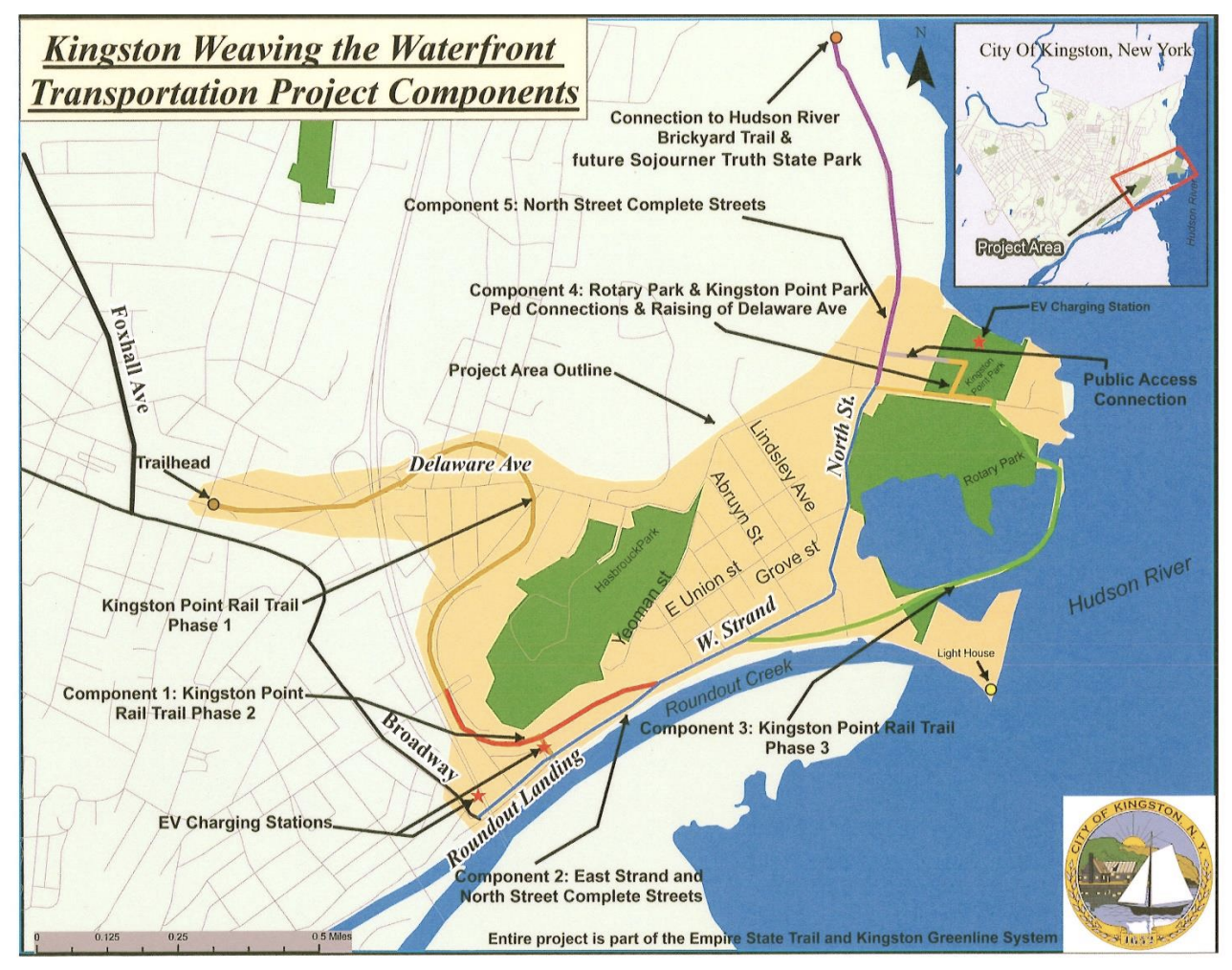
The Weaving the Waterfront Transportation Project consists of several connected improvement projects. Noble started with the least glamorous piece.
"It's going to help raise the road along East Strand and North Street, so that when we have these flooding events, the road doesn't flood as often as it does today, which sometimes could be every day, at least once a day," he said. "No one wants to have to see a huge puddle in the road every time there's a high tide."
A key aspect of the project is to extend the Kingston Point Rail Trail, which currently runs from Midtown down to the Maritime Museum.
"This grant helps to pay for a new transportation connection and recreational corridor from basically the Trolley Museum all the way out to Rotary Park and Kingston Point Beach," Noble said. "We know that will really get more people to use the trail, get more people to that section of the waterfront, and create a seamless off-road connection for people from Midtown Kingston to get all the way out to Sojourner Truth State Park. To be able to have it all be connected, we think is good for tourism, it's good for business."
Sojourner Truth State Park is no small part of the plan to create a thriving waterfront area. The state is currently working on a $75.5 million buildout that will turn the park into a full-service public recreation destination. Plans include a large swimming facility in a spring-fed quarry, a bathhouse pavilion, upgraded roads and parking lots, new trails, public restrooms, outdoor event space and interpretive installations.
Another major waterfront player is Hutton Brickyards, which continues to expand its operations – most notably with large-scale entertainment events like the Rolling Stone Stateside festival on July 4, which is expected to draw about 4,000 people.
"It's one of our largest economic development engines,” Noble said. “It brings in lots of events and many big concerts... This will help make sure that there are sidewalks so that concertgoers can come in and out of the festival area, and the restaurant, and the hotel."
With so much already going swimmingly for the developed areas of the waterfront, Noble frames the project as the key to unlocking the remaining tracts of land which have high potential for becoming prime real estate.
"We are one of the more unique waterfronts along the Hudson that is not completely built out right on the water's edge," he said. He credited the late Rob Ianucci for assembling and cleaning up waterfront parcels, removing "all of the junkyards and old abandoned oil tanks," which left "these cleared, ready-to-develop areas that we think are really prime for redevelopment."
The strategy is to lead with infrastructure. "By putting in all of this public infrastructure, we're really creating the foundation for private investment to occur and be successful," he said. "By securing all of this state and federal funding, we're also showing to the private development world that Kingston is investing in itself, and we hope that they will invest in us too."
Opportunities for growth
Noble has made new housing a central part of his economic development agenda, and that priority carries through to the waterfront project.
"We want all different levels of housing types. We want all different levels of affordability ranges. It'd be nice to even have a little grocery store," he said. "The more people that live in a business district, the better it is for businesses year-round."
He wants residents, not just weekend visitors. "We want feet on the street. We want people living and working and dining and recreating, all right here."
Kingston's waterfront is also a cultural draw, anchored by the Hudson River Maritime Museum and the sloop Clearwater. Noble sees that history as integral to the economy.
"We have some of the best museums in the Hudson Valley located right here in downtown Kingston along our waterfront," he said. "Not only do they employ people, but they attract so many other opportunities." He pointed to American Cruise Lines, which docks at the Maritime Museum nearly every day from spring through October. That traffic helped launch a new historic trolley tour business in the city.
"Without the cruise lines coming, that business model didn't work," Noble said. "And without the Maritime Museum, that cruise line wouldn't have come."
With the pandemic driving a dramatic rise in remote work, Noble sees developing the waterfront as the creation of much-needed real-world jobs.
"We have a lot of people that live in Kingston that work from home, or that work in home studios, that have these live-work spaces. So really by building housing, we are building jobs," he said. He expects continued growth in cultural institutions, services, tourism, and small retail. "Those jobs are all good jobs, and they help support our local economies."
The waterfront revitalization plan has been years in the making, with input from all corners of the city.
"We planned with the business community, with stakeholder groups, what vision do we want for the waterfront," he said. "When we get everybody's voice around the table, that allows us to make sure that we're making the right economic development decisions, and it clears the path for development." He credited the city's new zoning code with removing "a lot of the development obstacles” including reducing the “not in my backyard” mentality that can often stifle economic growth.
Timeline and disruption
As the RAISE grant is a federal one approved during the Biden administration, city officials were holding their breath as President Trump took office and began axing numerous transportation grants. Kingston’s grant ultimately remained intact.
"Just a few weeks ago, we got the notice to proceed from both the federal DOT and the state DOT," Noble said. Detailed design comes next, with construction expected in "2028, 2029." He was candid about the wait. "These federal grants take a really long time, but we're just very happy that the money is still here for us to use."
He expects the build itself to be manageable for nearby businesses. "These projects are streets and sidewalks, and we do that all the time, and these are relatively quick projects," he said. "It's just some new pavement, some new sidewalks, and some expanded trail amenities. I think it's going to be a relatively low-stress construction project."
Still fundraising
The RAISE award is the lion’s share of the funding received to upgrade the waterfront, but not the only money available. Noble subsequently secured another $1.5 million from the same federal partners. Senator Michelle Hinchey contributed $6 million toward repairing the bulkhead and adding a pedestrian walkway at the Maritime Museum, and Congressman Ryan earmarked $250,000 for design work on the rest of the waterfront.
Noble believes success builds on itself. "When you have a proven track record of success, it really does help us build upon that messaging and show to any of our funders that we can deliver," he said.
His closing message to the downtown business community was direct. "We're making these investments to help expand what the business district looks and feels like," Noble said. "More businesses breeds more business, and that's what we really want to do." He had a note for the owners who came first, the ones who took the early leap of faith. "We want to now provide them some backup, by allowing us to have even more economic development in that core area of Kingston."