The future, made locally: how a $1 million advanced manufacturing lab at the former IBM site is reshaping the regional talent pipeline
by Zac Shaw for Ulster Strong
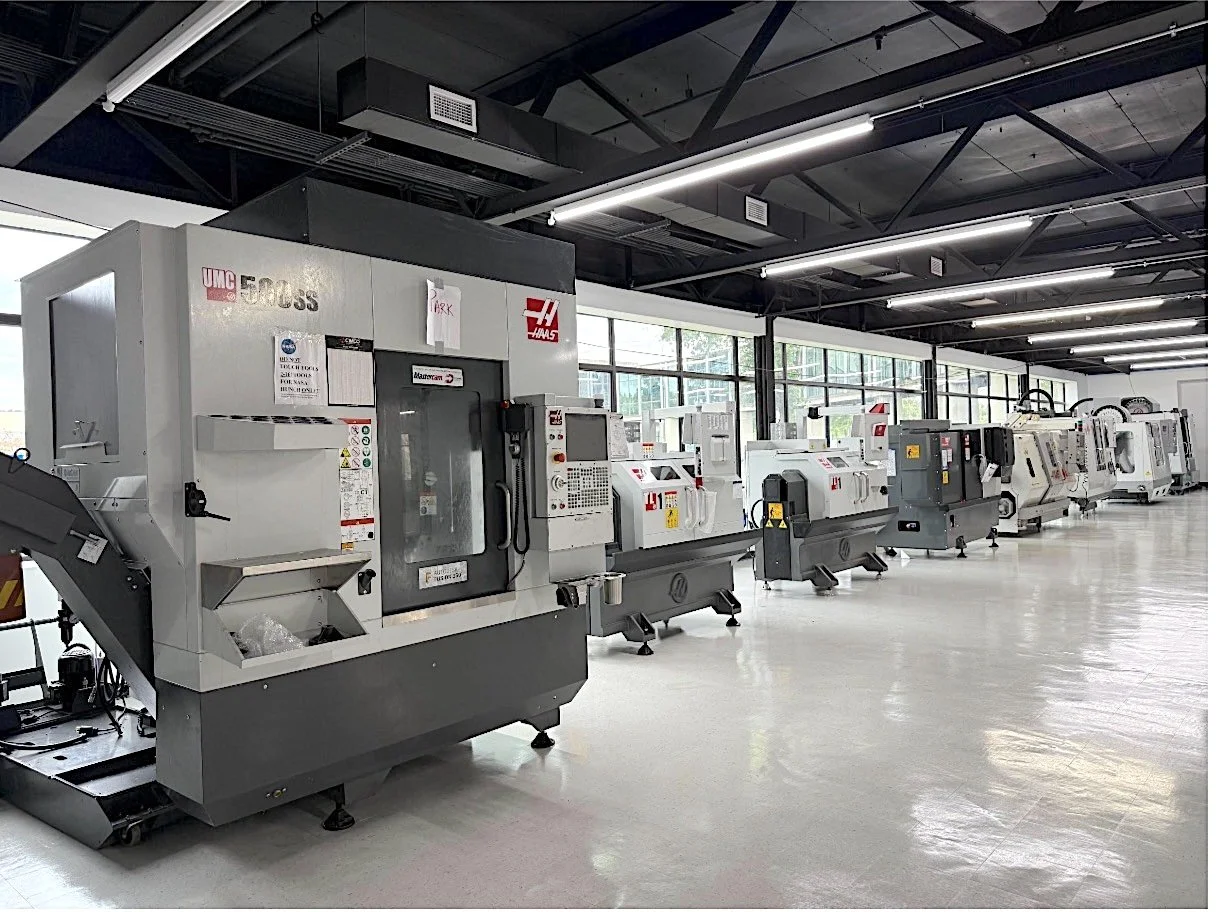
When students walk into the Gene Haas Manufacturing Futures Lab at iPark 87 in Kingston, they step onto the same floor where IBM once shaped the future of computing. Today, rooms full of cutting-edge technology set the stage for a new generation preparing to shape the future of manufacturing.
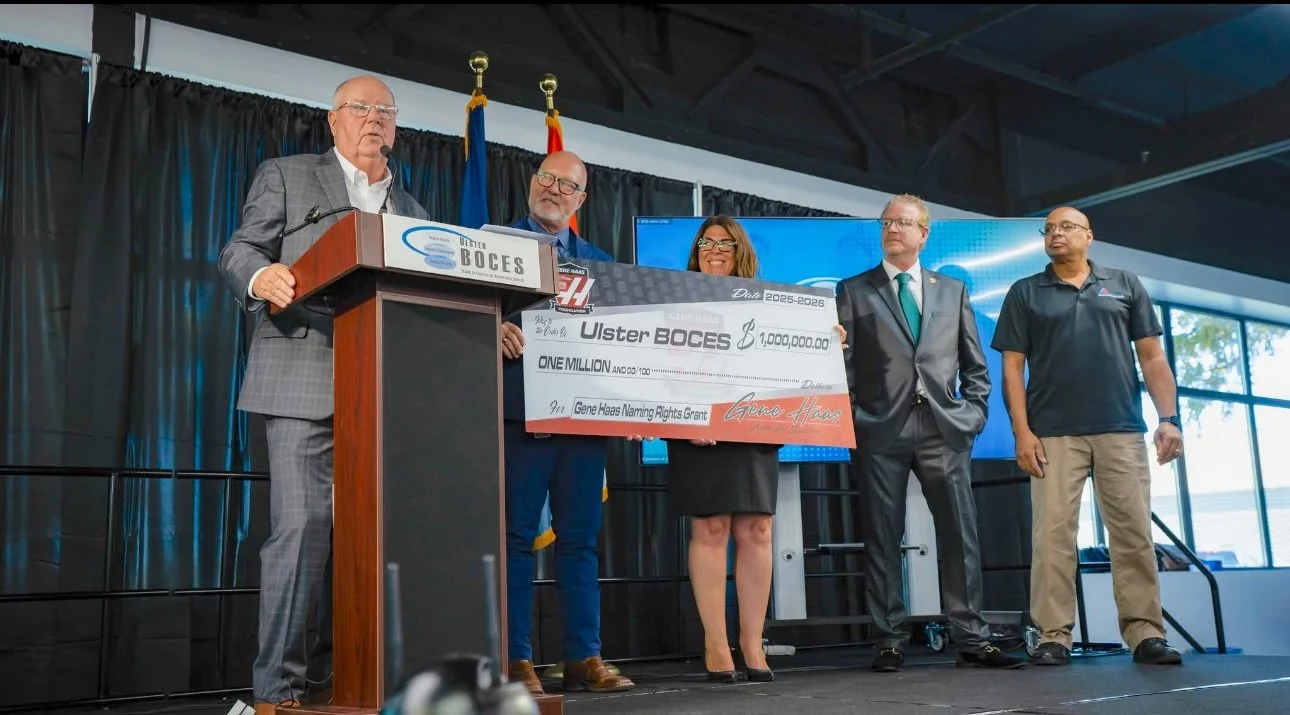
The $1 million lab opened in April as the centerpiece of the Ulster BOCES Career Academies. It’s the latest chapter in a workforce strategy that connects local high school students directly to industry-leading entities like Rensselaer Polytechnic Institute and startups like a Brooklyn drone maker that wants to transport human organs by air.
The lab houses a coordinate measuring machine, a laser cutter and engraver, multiple five-axis milling machines, and robotic arms that can feed and unload the machines on their own. By design, it all mirrors a modern shop floor.
"Once you handle the metal once, no matter what it is that you want to reductively do with that piece of metal stock, you don't have to handle the metal again by hand," said Peter Harris, Ulster BOCES's assistant superintendent of Career Pathway Programs. The robotic arms prepare students for a workplace where they will share tasks with machines.
“When I talk to my partners at Snap-on and Lincoln Electric, what they’ll tell you is the next generation of learners needs to expect that when they’re doing something like welding, they should expect to be manipulating the welding puddle at the same time as a robot or cobot is manipulating the welding puddle,” Harris said.
The path to helping students work hand-in-robotic-arm on advanced manufacturing tasks was a long one. The lab is the third generation of an Allendale and Haas-backed program at Ulster BOCES that began more than 20 years ago. Today, it is being shaped to do far more than train machinists.
In 2014, Ulster BOCES launched the Hudson Valley Pathways Academy, an early college high school program that now offers tracks in advanced manufacturing, pre-engineering, and Cisco cybersecurity. Students earn an associate’s degree alongside their high school diploma.
“The idea was putting those three legs of the triangle together,” Harris said, referring to BOCES, higher education, and industry. “You could get at understanding the skills that are necessary and sought after for and by industry to fill labor gaps and to bring the next leaders into their spaces.”
Out of that collaboration came what Harris calls the “learning threads,” a set of five core competencies that shape the curriculum.
“They got together, created these learning threads, which is leadership, creativity, multiple literacies, self-direction, and global citizenship or competence,” he said. “These are the five things that if our next employees have as skill sets, we’d be better off. We’d be better prepared, better poised to do the work that we want to do.”
Perhaps surprisingly, technical training comes second. Personal and professional development are paramount.
“We want good people who are employable,” Harris said. “Often they’ll say, we have the technical expertise, or we have the patent. Send us people that understand leadership and how to be coached, that can be self-directed in what they’re doing, that can be competent globally.”
Students at the lab are not building practice projects. They are filling purchase orders.
Through a connection to Newlab, the for-profit incubator at the Brooklyn Navy Yard, the program took on a supply chain challenge from an autonomous aviation startup. The company holds a patent on a drone designed to move soft tissue and organs through the air, taking medical courier services off the road.
“Tariffs have changed the market for him,” Harris said. “Before the tariffs, he was buying from China. He could get the supply chain he needed. But now the supply has shifted. Now actually the domestic as well as the Chinese supply chain is kind of broken.”
Tackling the challenge head-on, the startup ships in metal stock and tooling. Ulster BOCES students mill the parts and ship them back.
“We have produced 10 parts per month. The goal is that we’ll get to 80,” Harris said.
A second project came from Rensselaer Polytechnic Institute, where a group of seniors working on their final engineering project before graduation (also known as a capstone team) turned to high school students for help with a 300-unit production run.
“For the first time that I’m aware of, RPI’s electrical and mechanical engineering capstone program asked for high school kids to help them by manufacturing some pieces for a run of 300 fully assembled banks that they put together,” Harris said. “Our kids had the opportunity to mill the metal for those banks.” Those students will travel to RPI on May 6 to present alongside the college engineers.
Harris points to one student, Jacob, as an example of how the model is working. Jacob entered the program in ninth grade. He now works 30 hours a week as a paid intern at Viking Industries and is taking college classes on a track to a manufacturing engineering credential.
When the BOCES team called Jacob last week to ask if he wanted to fly to the First Robotics World Championships in Houston, he hesitated because of his work schedule.
“We’re like, we’re going to call your employer, and we think he’ll understand that the program he’s helping to design is providing this opportunity,” Harris said. The employer agreed.
“The program’s providing his higher ed opportunity at no cost to himself or his family,” Harris said. “Then it’s providing him with the opportunity to have a supported internship that’s paid. Then it’s actually working with the employer to say, we want to send them to Houston for a week to learn what’s happening at the World Championships. Experiential learning, expeditionary experiences, great high-quality mentoring with pay. Where do you get that?”
Concerns that students will have to leave the region for manufacturing work are misplaced, Harris said.
“There are lots of contracts that the government has with the manufacturers here,” he said. “There are all these open positions. There aren’t open positions that people are trained for necessarily. We’re working to connect with that truth.”
The lack of a trained workforce to fill these jobs is a supply and demand problem that is poised to expand rapidly in the near future. America is looking to bring more advanced manufacturing within its borders, and New York is being eyed as a major supplier of talent.
Federal CHIPS Act funding is expected to support Micron’s massive semiconductor manufacturing project in Clay, outside Syracuse. The project is projected to create about 9,000 direct Micron jobs and nearly 50,000 jobs overall, including construction, supplier and related community jobs. Harris said the impact will extend beyond Central New York, forcing career and technical education programs statewide to adapt to emerging technologies and new workforce needs.
“That doesn’t just impact Syracuse and Clay. That’s going to impact our entire state because we will need to adjust as career pathways people to the emerging technologies that need training we aren’t currently working on,” he said.
Harris said the reality is that “most people do not work in the zip code in which they live,” and high-tech skill sets “should be portable so that we can keep our kids in New York’s economy and they can migrate within it.”
The Ulster BOCES project relies on close relationships with businesses to guide curriculum, and Harris encouraged businesses to reach out and become part of the sea change happening in local education and industry.
“They can participate by sending a person who actually is working in the field, on the ground floor, doing the work, and sending them to guest speak, providing a learning experience on their shop floor or in real time on what they’re doing, which is called an exposure,” he said.
Beyond that, companies can join the program’s advisory committee, host work-based learning challenges, and help shape the curriculum directly.
“That’ll help us set curriculum and set goals,” Harris said.
He pointed out that the whole enterprise is built so visitors can see it for themselves. The Career Academies were designed with overhead glass garage doors at the front of every lab.
“It’s trite to say this, but you can’t be what you can’t see,” Harris said. “When you walk through our space, you can look in and say, oh, that’s the manufacturing lab. Those machines are interesting. That’s the aviation classroom. That’s early childhood. That’s natural resources and ag science. That’s our cosmo space.”
The point is not just to train workers. It’s to help students discover who they want to be and how they want to shape their careers and lives.
According to Jonah Schenker, District Superintendent & Chief Executive Officer of Ulster BOCES “what we are building at iPark represents a fundamental shift in how we think about education and workforce development. This is not about preparing students someday, it is about connecting them now to the ecosystems of industry, higher education, and innovation that define our region. By aligning these systems, we are creating a living pipeline where students contribute to real work, develop durable skills, and see themselves as part of the future of manufacturing and beyond. This is how we ensure that the future of our region is not left to chance, but intentionally developed and grown right here through design.”
“We’re growing employable, good humans,” Harris added. “Or we’re growing good humans who are employable.”