
Nature vs. neighbors: Environmental review reform is on the table as state and local officials acknowledge process is stifling growth
by Zac Shaw for Ulster Strong
Most locals agree that preserving the environment is important, just as most agree with the need to preserve housing availability and economic vitality. Yet the two goals have grown increasingly at odds in New York State and especially in the Hudson Valley. Developers face unprecedented challenges and costs in building much-needed homes, jobs and businesses under environmental scrutiny that can appear to be general opposition to development rather than a serious commitment to balancing nature with human needs.
Roughly fifty years after the state’s first environmental review laws hit the books, it finally looks like the tide might be turning to loosen the stranglehold environmental reviews are having on local economic growth that benefits the community.
The State Environmental Quality Review Act, known as SEQRA, requires state and local agencies to study potential environmental impacts before approving a wide range of public and private projects. With New York facing a severe housing shortage and rising infrastructure costs, a growing chorus of state and local officials are calling for reform.
Gov. Kathy Hochul is pushing the most significant rewrite of SEQRA in decades as part of her “Let Them Build” agenda. The governor has cited studies showing that manufacturing, energy and housing projects can take as much as 56 percent longer to move from concept to groundbreaking in New York versus peer states.
Kingston Mayor Steve Noble joined in harmony, calling for environmental review waivers for much-needed housing development in Ulster County’s only city. In a March 16 letter to Assembly Speaker Carl Heastie and Senate Majority Leader Andrea Stewart-Cousins, Noble urged state leaders to advance Hochul’s SEQRA changes, arguing that “reasonably sized” housing proposals on “previously disturbed land” should be able to move forward without a full SEQRA process.
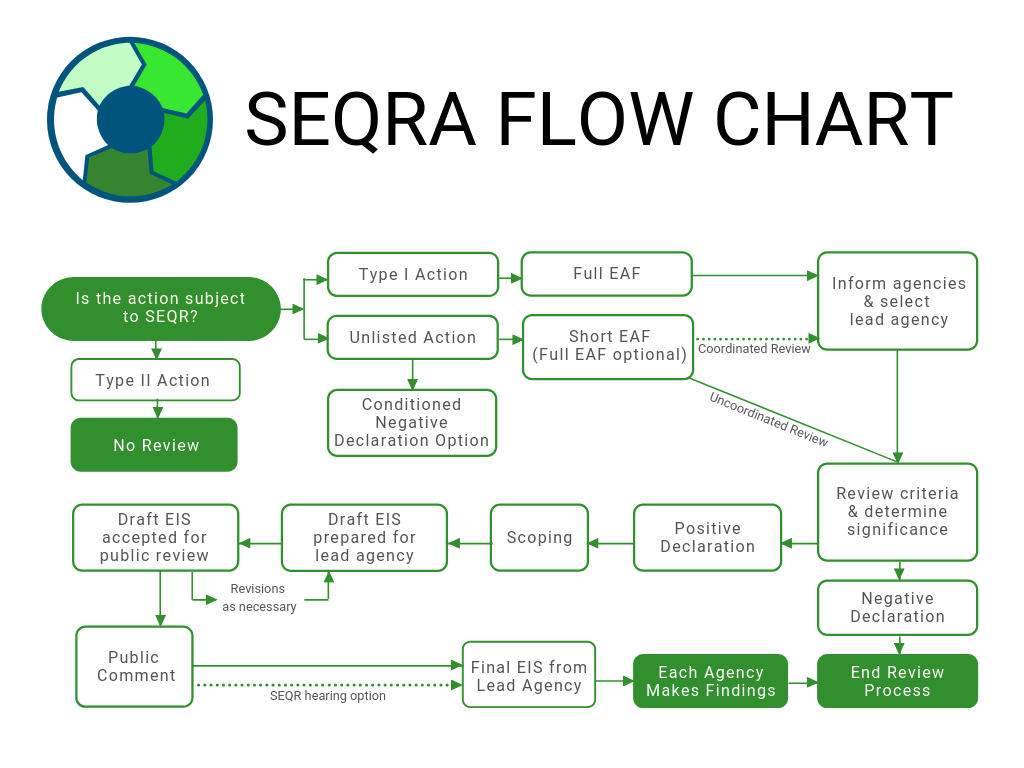
How SEQRA works, and why it takes so long
SEQRA is a procedural law. It does not ban development outright. Instead, it requires the “lead agency” for a project, often a planning board or municipal board, to identify potential impacts and decide whether those impacts may be significant.
Many actions start with an Environmental Assessment Form, or EAF, which functions as an early checklist and narrative of what a project is, what resources it may affect, and what mitigation is proposed.
From there, projects typically flow into one of two pathways. If the lead agency concludes there will be no significant environmental impacts, it issues a “negative declaration,” and the SEQRA process ends.
If the lead agency finds otherwise, it issues a “positive declaration,” triggering a full Environmental Impact Statement, or EIS. The EIS process is where timelines can stretch. It can involve scoping, multiple rounds of draft and final statements, public hearings, responses to comments, and coordination with “involved agencies” that have related permitting authority. SEQRA also allows for lawsuits challenging whether the agency took the required “hard look” at impacts and provided a reasoned basis for its decision. Opportunities for added delays and costs are manifold.
In practice, the line between “no significant impact” and “potentially significant impact” can become a battleground, especially when local opposition is strong or when a project touches contentious issues like traffic, water, wetlands, neighborhood character, or climate. Take the Zena Homes saga in Woodstock.
Announced in 2023 and originally titled Woodstock National, a proposed original plan to develop 191 homes, a golf course and helipad was scaled down to just 30 homes built in the Town of Ulster. The issue? The only access road must go through Woodstock land. And it’s a big issue, because Woodstock has been historically hostile to development of most kinds.
In fact, drive into town today and you’ll see a sign put up by the Stop Zena Development group that says “Developers profit, Woodstock pays. Protect our water, our safety, our tax dollars.”
After the Town of Ulster planning board was designated lead agency in the project, Woodstock Land Conservancy sued to dispute the designation. Opponents have argued that the project raises serious safety and ecological issues, including emergency access on a long private road, forest fragmentation, and adverse impacts on “amphibian crossings”.
In response, developers have pointed out the project has already been subject to extensive environmental review and that they have redesigned elements to reduce disturbance.
In March, the Town of Ulster Planning Board delayed a determination on whether the project should receive a negative declaration or be pushed into a full EIS, citing the need for a site visit. Nearly three years after it was first introduced to the planning board, the development remains stuck in the bureaucratic mud. And it may be there awhile longer.
Even when a project ultimately receives a negative declaration, opponents can use the process to demand more studies, raise new issues, and threaten litigation. The Citizens Budget Commission, a nonpartisan fiscal watchdog, has estimated that permitting and “red tape” can add the equivalent of tens of thousands of dollars per housing unit in New York City, which adds insult to the injury of long review timelines creating enough uncertainty to kill projects before they are built.
That uncertainty has also produced a professional ecosystem around SEQRA: environmental consultants, land-use attorneys, and specialized engineers who prepare studies, manage submissions, and defend records in court. To critics, it is a cottage industry that profits from complexity. Supporters say it’s all necessary to avoid mistakes that could harm water, air, habitat, or public health.
Road to reform
Hochul’s “Let Them Build” proposal would create new SEQRA exemptions for certain housing projects in areas with existing water and sewer, provided they meet criteria tied to zoning, flood risk, and “previously disturbed land,” and it would also exempt some infrastructure work, including clean-water upgrades, green infrastructure, parks and trails, and child-care facilities when similarly sited.
Her proposed changes would impose a two-year cap to complete Environmental Impact Statements, clarify when SEQRA lawsuits can be filed by defining when a challenge “accrues,” expand the use of Generic Environmental Impact Statements so recurring impacts can be studied once instead of project by project, and provide more training and support for volunteer local boards. The reforms are being negotiated in the state budget. So far, the Senate appears more receptive than the Assembly, which may be eyeing a reduction in scope.
Two issues repeatedly surface in the pushback.
First is the definition of “previously disturbed land.” Critics argue that if the term is applied too broadly, it could cover ecologically sensitive sites. In legislative hearings and public forums, some advocates have warned that the language of the law could be interpreted to include developments on maintained lawns or other landscapes that are not pristine wilderness but still matter for runoff, groundwater recharge, and biodiversity.
Second is the fear that streamlining could weaken public participation and local leverage. Those focused on environmental preservation are not keen to lose any tool in their toolbox that aids in opposing development.
Still, momentum is shifting toward rebalancing environmental oversight and development, and not just in New York. California reformed its environmental review process in 2025, creating broader exemptions for certain “infill” housing projects, tightened timelines, and limited the scope of review for some projects that nearly qualify for exemptions. Similar changes are underway in Massachusetts, Washington, and Minnesota.
Back in New York, Albany’s budget talks will decide how far Hochul can go this year. But the pressure behind the issue is unlikely to fade. New York’s housing shortage, high construction costs, and aging infrastructure are forcing policymakers’ hands despite widespread and well-funded environmental activism that has long placed limits on economic development in the Hudson Valley.