
Feed the need: The Granary in Accord seeks to build on the hamlet’s momentum towards economic growth
by Zac Shaw for Ulster Strong
Five years in the planning, The Granary is a mixed-use hospitality development seeking to revitalize the long-neglected former Anderson Feed Mill and Supply Complex in Accord. The feed mill’s demise is linked to Accord’s fall from economic grace in the 1980s, hastened by an earlier shutdown of rail service. Fortunately, the hamlet has recently been revitalized by a fresh wave of transplants and upscale attractions like Inness and Skate Time.
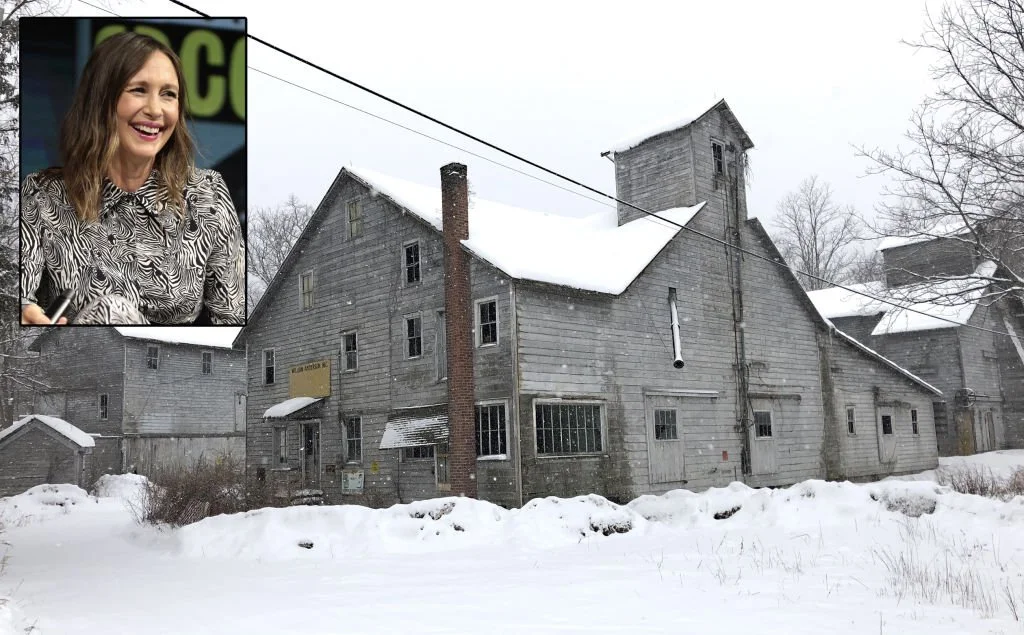
The vision for The Granary is a kaleidoscopic new addition to Accord’s economic landscape. It’s been proposed as a 16-room bed-and-breakfast, a 75-seat restaurant and bar with an outdoor beer garden, an event space, a garden space, a bike shop with rentals and repairs, a café, a coworking space and a community center.
“We would love to be open for next spring/summer,” said Henry Rich, a managing partner in the development. “People have been brainstorming ways to revitalize the main commercial sites for decades, but during this time the building has fallen into greater disrepair, and two of the buildings on site have fallen down,” he said, reflecting on the long path toward launching the project.
The attempt to turn blight into an economic boom has turned heads for a few reasons, not the least of which is its high-profile backers: Film and TV star Vera Farmiga and accomplished musician/producer Renn Hawkey are partners in the development.
Besides the celebrity backing, some locals are scrutinizing the project for concerns all too familiar to developers in Ulster County’s rural regions. Will there be more traffic? More noise? Will the historic, rustic character of the hamlet be impacted? Will tax exemptions offered to developers be similarly fruitful for local taxpayers?
“The point of the project is to revitalize the hamlet with more activity, so we are hoping for more traffic,” Rich said. “The activity will never reach the historic level when more than 100 people worked at the site and hundreds got off the train for the weekend, but we hope that the restaurant will be full every night.”
He said traffic analysis has been part of the process. “Traffic studies have been done by the county,” Rich said. “The additional traffic is minimal compared to the traffic coming off of 209 going to Granite or Towpath and is significantly less than other commercial sites in town that feed onto 209, which have shown no adverse effects to traffic.”
Noise, he said, is being handled with a stricter limit than nearby residences. “As far as noise goes, we were asked to follow a stricter code than neighboring homes, five decibels above ambient at the property line,” Rich said. “There will be more people walking, biking; the point of the project is to revitalize these buildings and Main Street with more life, activity and local businesses similar to other towns’ hamlets and Main Streets.”
Whether you would describe such a development as a boon, or as one resident put it, a “carnival,” is a subjective matter.
And the debate becomes even more philosophical. Some residents are asking government boards to treat the hamlet’s residential character as the priority, and to limit what the project can do outdoors. Rich, by contrast, points to planning language about revitalization.
“This was the state of Main Street historically,” he said. “As far as whether this is an adverse impact depends on your point of view, but this kind of historic revitalization is taken more or less line by line from the town comprehensive plan, Ulster County sustainable development goals and the mission of NY Restore.”
“Once this site is revitalized,” he said, “not only will it create jobs for the people who live in the community, but we hope Main Street will become filled with foot traffic that can support local business in the other commercial storefronts, most of which are currently boarded up.”
“Rochester also has a shortage of small (or large) local businesses and places to work for its residents,” Rich said. “Compared to neighboring towns that have invested in their hamlets and seen local makers, farmers and artisans flourish from Rosendale to Marbletown to Wawarsing, there are very few jobs on offer for locals.”
“We’re creating 15–20 jobs depending on how busy we are,” he said. This is in addition to an estimated 40 construction jobs the project will require to be built.
“Eighty-five percent of the population has to leave the town to find work,” Rich said, “a condition different from most towns in the county, so Rochester has a unique need for revitalization and jobs, especially in the hamlet.”
With noise, traffic, character and jobs covered, there’s one remaining area of skepticism, and a perennial one at that: Will local taxpayers benefit from the payment in lieu of taxes (PILOT), which at the time of writing is still under review by the Ulster County Industrial Development Agency (IDA)?
“The Granary is financed through a combination of equity, debt and economic development grants,” Rich said.
“The idea behind the PILOT is to support the project financially in the initial years after launch,” he said. “I agree that a project needs to justify its PILOT application in terms of community benefit.”
In his view, the site’s baseline contribution is unusually low because of its condition, and that the proposed schedule would still increase what the project pays. “When it comes to this site, the property spent most of the past few decades paying no taxes at all and was sold at tax auction,” Rich said. “Our taxes are currently extremely low, reflecting the derelict nature of the site.”
The IDA application includes a 15-year abatement schedule. In year one, it shows estimated PILOT payments of $5,590, with an “estimated total with PILOT” of $13,681, increasing each year as the abatement steps down. Over the full 15 years, the schedule totals $902,081 in estimated PILOT payments, alongside $1,041,998 in “estimated total with PILOT,” with a much higher “without PILOT” projection.
“In the first year of our program, our taxes will more than double and go up every year from there,” he said. “At the end of the program, we’re projected to be paying more than 20 times what the current assessment is. As far as PILOTs go, we believe this one is a good investment in terms of paying into the town coffers.”